Parmigiano Reggiano vs parmesan: one cheese in Europe, two in America
Car, or no car?A dairy visit booked direct costs €15–35. What the tours below sell is the ride out to the dairy by 9am, and the ham and balsamic stops.
Compare all sevenThere are three things here, not two
Most of the arguments I hear about this start from the idea that parmesan is either the same cheese as Parmigiano Reggiano or a copy of it. Neither is quite right, because the word means different things depending on which side of the Atlantic you are standing on. So I keep three things apart: the word “Parmesan” as European law reads it, the word “parmesan” as American law reads it, and the cheese that is made every morning in the dairies around my home town. Once those are separate, the question answers itself.
In the EU, Parmesan is a protected word
On 26 February 2008 the EU Court of Justice decided case C-132/05 and held that “Parmesan” evokes the protected designation Parmigiano Reggiano. In practice that means that inside the European Union, the English word is not a loophole. A cheese that is not made under the Parmigiano Reggiano rules cannot borrow the word Parmesan to get onto a shelf. The judgment is on EUR-Lex, under case C-132/05, and it is short enough to skim.
So if you are anywhere in the EU and a label says Parmesan, the law treats it as a claim to be the real thing. That is the EU half of the answer.
In the US, parmesan is a recipe standard
American law does the opposite. The Food and Drug Administration keeps a standard of identity for parmesan at 21 CFR 133.165, and it defines the cheese by what it is, not where it comes from. It may contain at most 32 percent moisture, its solids must contain at least 32 percent milkfat, and it must be cured for at least 10 months. There is no origin requirement at all. A wedge sold as parmesan in an American supermarket can be made in the United States or in any other country and still be exactly what its label says.
I want to be fair to it. American parmesan is not a fake Parmigiano Reggiano. It is a different cheese that shares a name, legally and openly. It is simply held to a looser rule: two months less aging at the minimum, and none of the constraints on place, milk and ingredients that follow below.
| Parmesan in the US | Parmigiano Reggiano | |
|---|---|---|
| Rule | Federal standard, 21 CFR 133.165 | The disciplinare, a protected EU designation |
| Minimum age | 10 months | 12 months, with no maximum |
| Where it can be made | Any country | Parma, Reggio Emilia, Modena, Bologna left of the Reno, Mantua right of the Po |
| What the rule fixes | Moisture at most 32%, milkfat in solids at least 32% | Raw milk, salt and calf rennet; no additives or preservatives |
What the real thing has to be
Parmigiano Reggiano is made under a set of production rules, the disciplinare, and they are strict. The milk is raw, meaning it gets no heat treatment, and the evening and morning milk has to reach the dairy within two hours of milking. Silage is forbidden in the cows’ feed. The only other ingredients are salt and calf rennet, plus a natural whey starter kept back from the day before. No additives, no preservatives. Each wheel ages for at least 12 months, and most of what is sold is 24 to 36 months old.
The zone is the part people most often get wrong. It is the provinces of Parma, Reggio Emilia and Modena, plus the part of the province of Bologna left of the River Reno and the part of the province of Mantua right of the River Po. Mantua is in Lombardy, so the zone reaches beyond Parma and beyond Emilia-Romagna. I have written out the morning in the vat step by step on how Parmigiano Reggiano is made.
How to tell them apart on the shelf
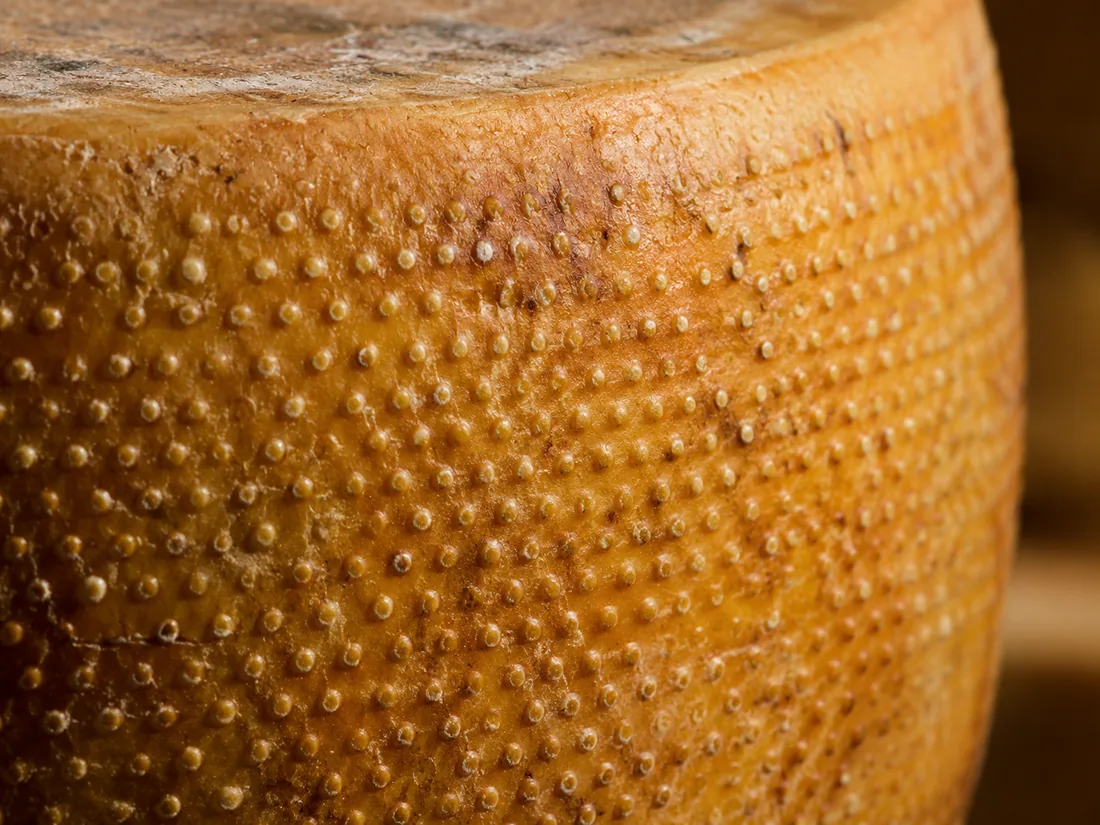
Parmigiano Reggiano carries its identity on the rind, and there are three marks to know.
- The dotted lettering. “PARMIGIANO-REGGIANO” is written in pin dots all the way round the side of the wheel, together with the dairy’s number and the month and year of production.
- The casein plate, a small label pressed into the rind with a unique code for that wheel.
- The fire-brand, the Consorzio’s oval mark, which goes on only after the wheel has passed inspection at 12 months.
Two further marks tell you about quality rather than identity. A second-grade wheel, called Mezzano, has parallel lines engraved into it. A wheel that fails outright has its marks scraped off, and it can no longer be sold as Parmigiano Reggiano at all.
In the United States, the simplest test is the word itself. If the label says Parmigiano Reggiano and the rind shows the dots, you are holding the Italian cheese. If it says parmesan, you are holding something made to the federal standard, which may be perfectly good and is a different product.
The easiest way to be sure
Buy it at the dairy. Dairies sell direct from their own shop, the spaccio, and the wheels in the aging room behind it are the ones you just walked past. You can book a visit yourself, without a tour, and I have set out exactly how on visiting a dairy without a tour. If you are planning to carry some home, read bringing cheese home first, because the rules for Britain changed in 2025.
 Cheapest near Parma
From Milk to Wheels: Parmesan Tour & Tasting in Parma
 Dairy only
Parma: Traditional Cheese Factory Visit with Tasting
 Most booked
Parma: Parmigiano Production and Parma Ham Tour & Tasting
Frequently asked questions
Is parmesan the same as Parmigiano Reggiano?
In the European Union, legally yes: the EU Court of Justice ruled in case C-132/05 (26 February 2008) that “Parmesan” evokes the protected name, so it cannot be used for anything else. In the United States, no. There parmesan is a generic federal standard, 21 CFR 133.165, that a cheese from any country can meet.
Why can American cheese be called parmesan?
Because US law defines parmesan by composition and aging, not origin: at most 32% moisture, at least 32% milkfat in the solids, and at least 10 months of curing. It is a different cheese sharing a name openly, not a counterfeit of the Italian one.
How can I tell if Parmigiano Reggiano is real?
Look at the rind for the dotted “PARMIGIANO-REGGIANO” lettering, which also shows the dairy number and production month and year, and for the Consorzio’s oval fire-brand. A small wedge may show few dots or none, because the lettering runs round the side of a very large wheel, so no lettering is not proof of a fake.
Is Parmigiano Reggiano aged longer than parmesan?
At the minimum, yes: 12 months against the US standard’s 10. In practice the gap is wider, because most Parmigiano Reggiano sold is 24 to 36 months old. The age bands and what they taste like are on how it is made.
Is Parmigiano Reggiano vegetarian?
No. The production rules require calf rennet, and nothing else may be used to set the milk. The short answer is here.