How Parmigiano Reggiano is made, from milk to wheel
Car, or no car?A dairy visit booked direct costs €15–35. What the tours below sell is the ride out to the dairy by 9am, and the ham and balsamic stops.
Compare all seven1. The milk
Everything starts with milk from two milkings, the evening’s and the morning’s, and it has to reach the dairy raw, within two hours of milking. Raw means no heat treatment at all. The cows’ feed is controlled too: silage is forbidden. How much milk makes one wheel is a figure the Consorzio itself gives two ways. Its glossary says 550 litres; its 2019 guidelines say about 520 litres. I report both, because I have no way to pick between two numbers from the same source.
2. The copper vat
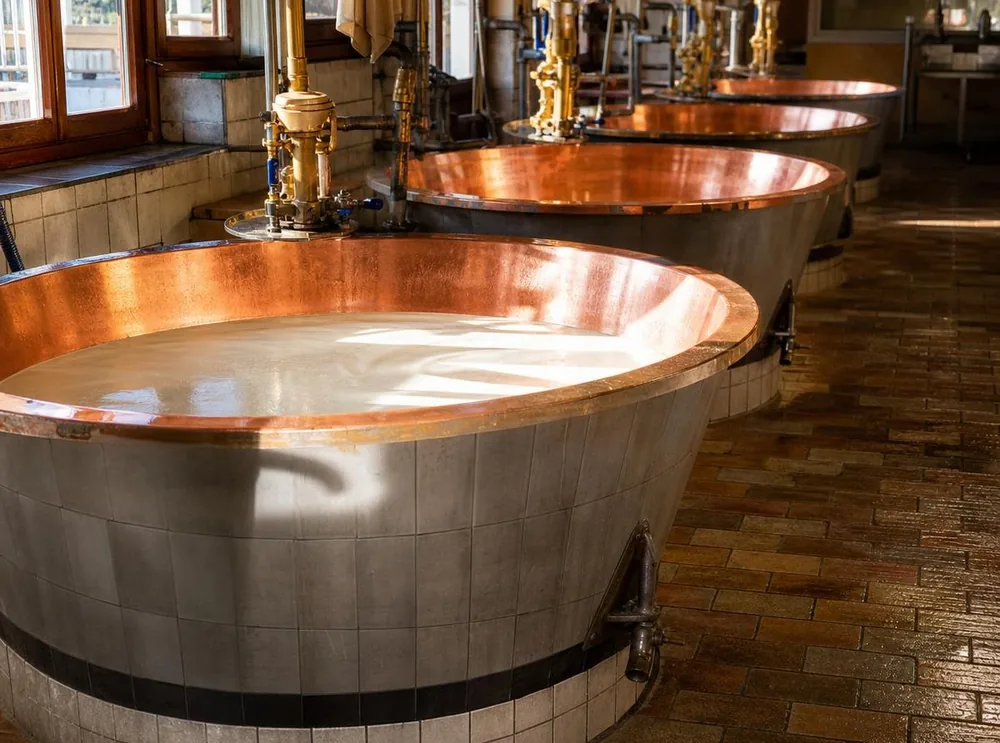
The milk goes into deep copper vats. Two things are added. The first is a natural whey starter, whey kept back from the previous day’s cheesemaking. The second is calf rennet, which sets the milk; the rules allow nothing else for that job, which is why the cheese is not vegetarian. There are no additives and no preservatives. Each vat is used once a day.
3. Breaking, cooking and settling the curd
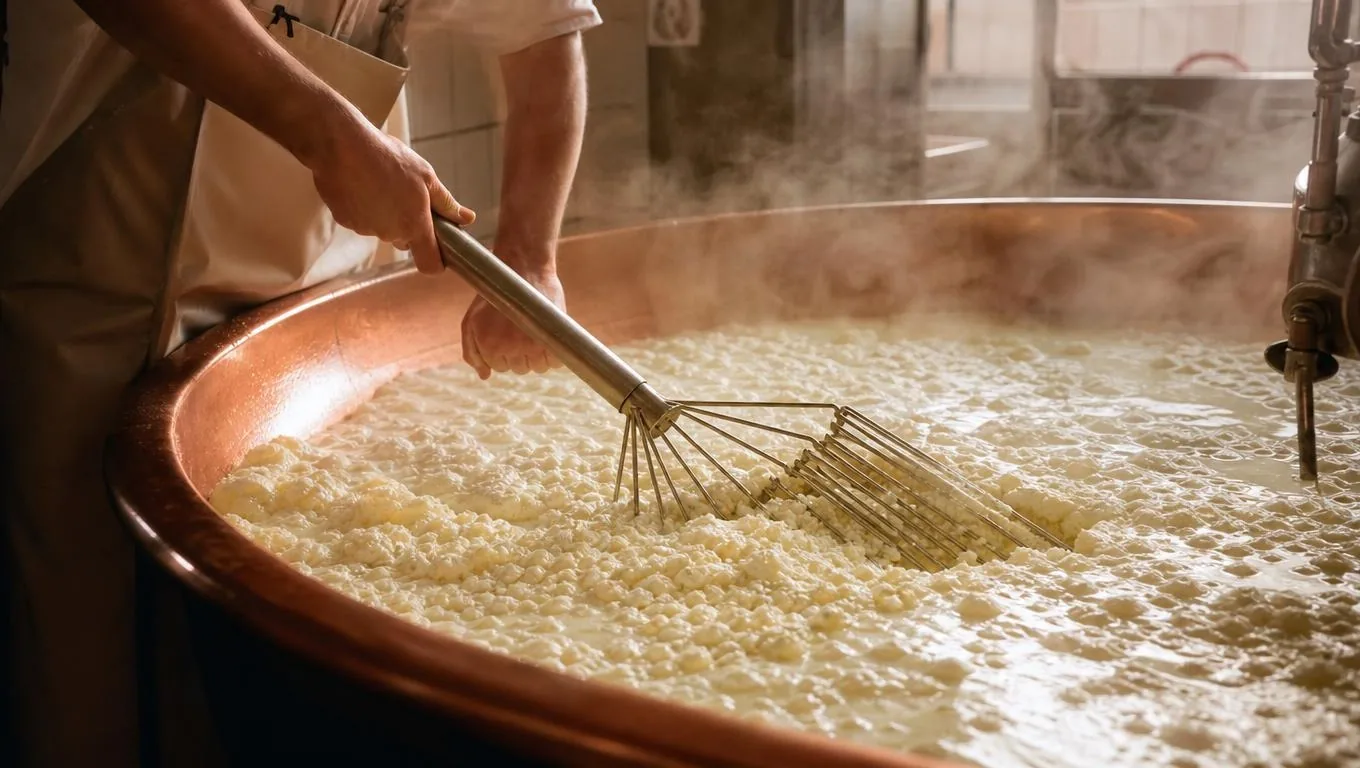
Once the milk has set, the curd is broken up, cooked and left to settle to the bottom of the vat. The rules require all of this, from coagulation to settling, to be finished by the end of the morning. That single line in the disciplinare is why a dairy visit has to be early, which I explain on what time to visit.
4. The extraction
This is the moment. The cheesemakers lift the whole mass of curd out of the vat in linen cloths, cut it in two, and put each half into a mould. Two wheels from each lift. My grandfather was a casaro, a cheesemaker, and this still looks to me like something that should need more people than it does.
5. The marks
A wheel carries its identity on its rind. The dotted “PARMIGIANO-REGGIANO” lettering runs all round the side, with the dairy’s number and the month and year of production. A casein plate with a unique code identifies that individual wheel. The third mark, the Consorzio’s oval fire-brand, has to be earned later. How to read these on a shop counter is on Parmigiano Reggiano vs parmesan.
6. The brine
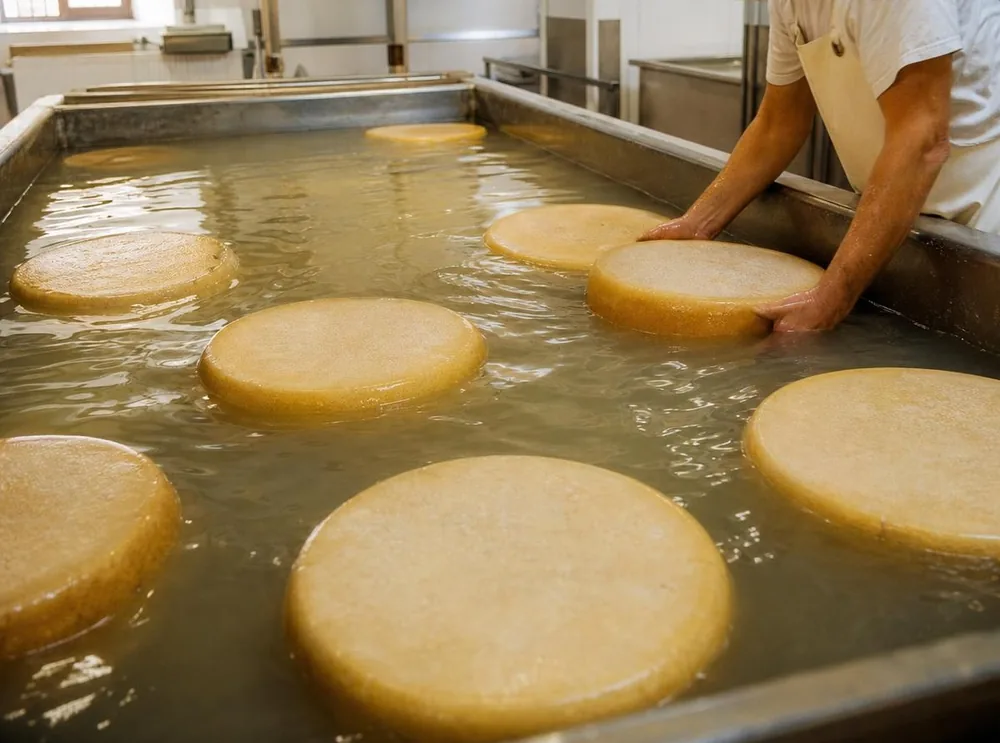
The young wheels are salted in brine, which is salt water. You will read a precise number of days for this in many places. The rules do not set one, so I do not give one either.
7. Aging
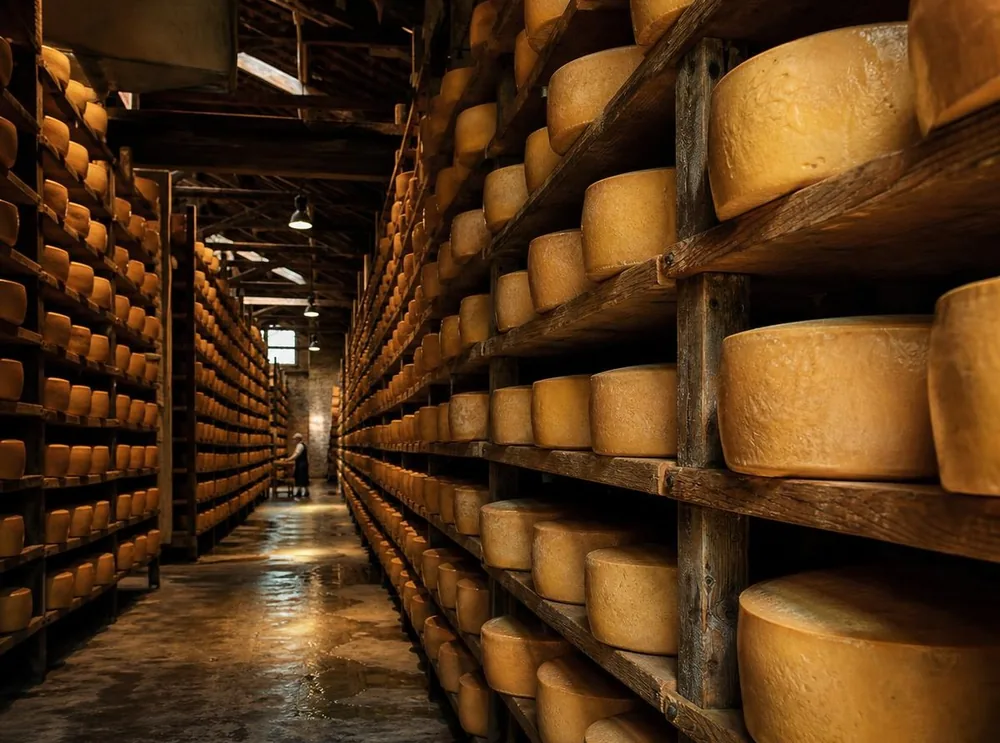
Then the wheels go onto the shelves, and wait. The minimum is 12 months and there is no maximum. Most of the cheese sold is 24 to 36 months old. A finished wheel is 35 to 43 cm across and 20 to 26 cm high, weighs at least 30 kg, and on average about 40 kg by the Consorzio’s glossary or 40.5 kg by its 2019 figures. The aging rooms are not necessarily cold: the rules set a summer minimum of 16 °C.
8. The battitore and his hammer
At 12 months every wheel is tested by a battitore, an inspector who taps it with a hammer. It takes about ten seconds a wheel. The Consorzio had 25 of them in December 2023; some press reports say 24, so I give you both. What the hammer decides is the wheel’s future:
- A wheel that passes gets the Consorzio’s oval fire-brand.
- A second-grade wheel, Mezzano, gets parallel lines engraved into the rind.
- A wheel that fails has its marks scraped off and can no longer be sold as Parmigiano Reggiano.
Age labels, and what each age tastes like
The rules give four age labels: delicato for 12 to 19 months, armonico for 20 to 26, aromatico for 27 to 34 and intenso for 35 to 45. The Consorzio describes the taste roughly like this. At 12 to 18 months, milk, yoghurt and fresh fruit. At 22 to 24 months, crumbly, with dried fruit and broth. At 30 to 36 months, very grainy, with spice and nuts. Past 40 months, spicy.
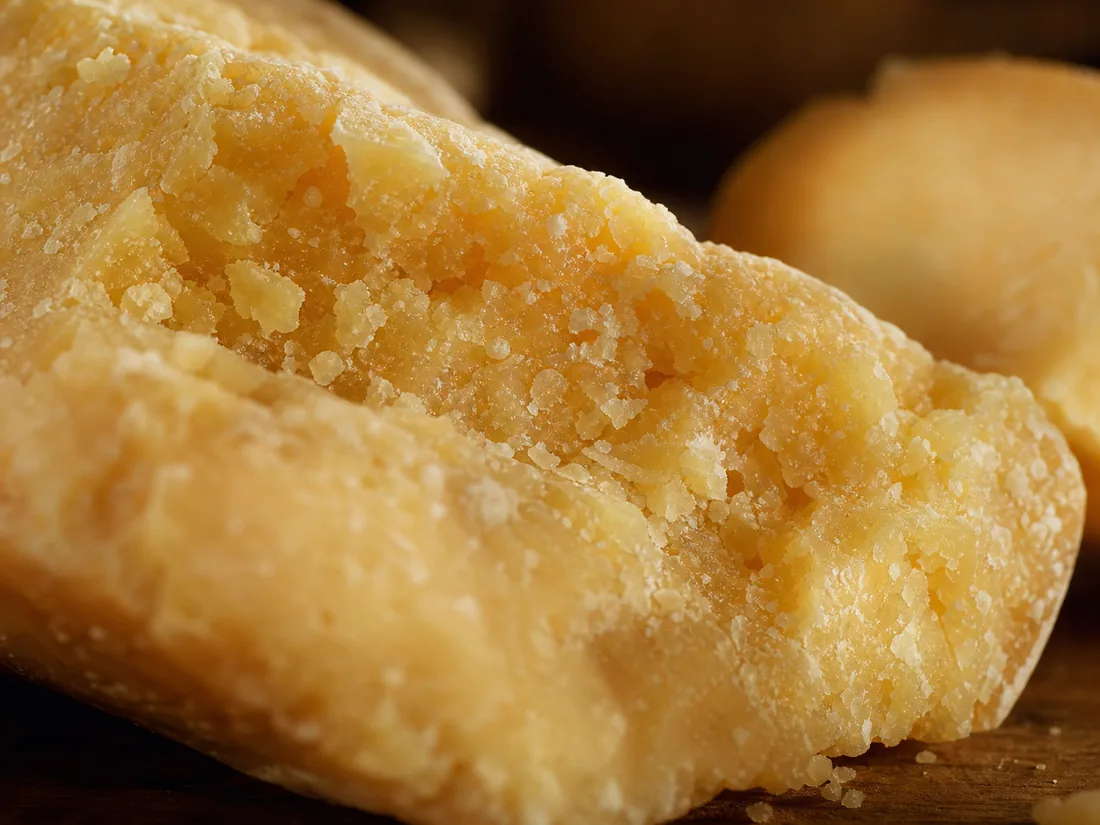
The white crunchy specks you find in older cheese are crystals of tyrosine, an amino acid, not salt, and they grow with age. The rind is natural and untreated, so it is edible once you clean it. And because the lactose is gone within the first 48 hours, the cheese is naturally lactose-free at every age, which I explain on is it lactose free.
How much of it there is
The dairies made 4.19 million wheels in 2025, up from 4.079 million in 2024, and 1.391 million of them came from the province of Parma. The number of dairies is harder to pin down, and I set out the sources on how many dairies there are.
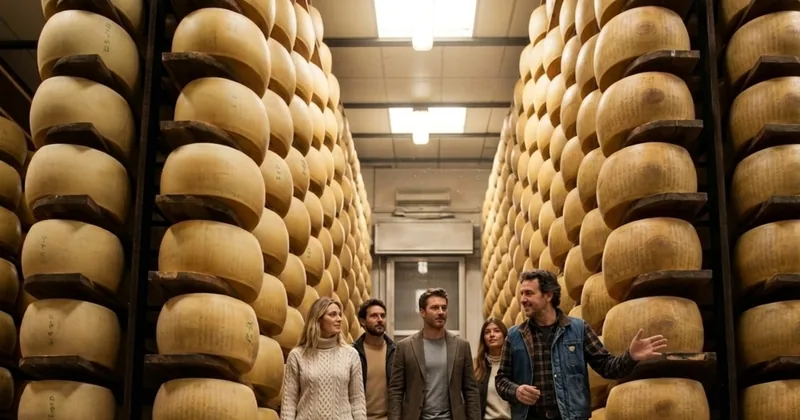 Cheapest near Parma
From Milk to Wheels: Parmesan Tour & Tasting in Parma
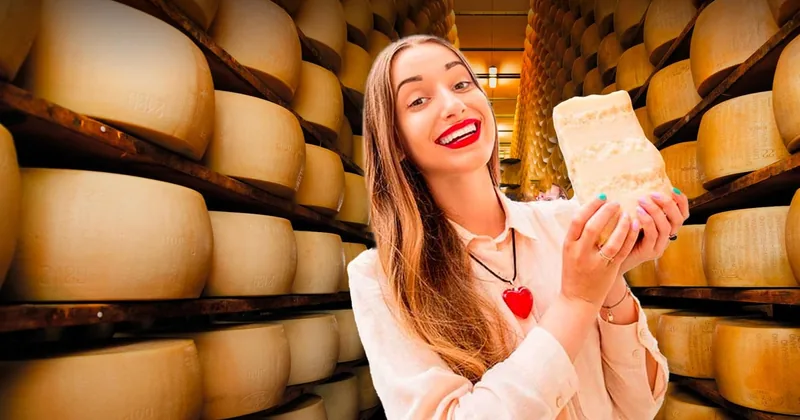 Dairy only
Parma: Traditional Cheese Factory Visit with Tasting
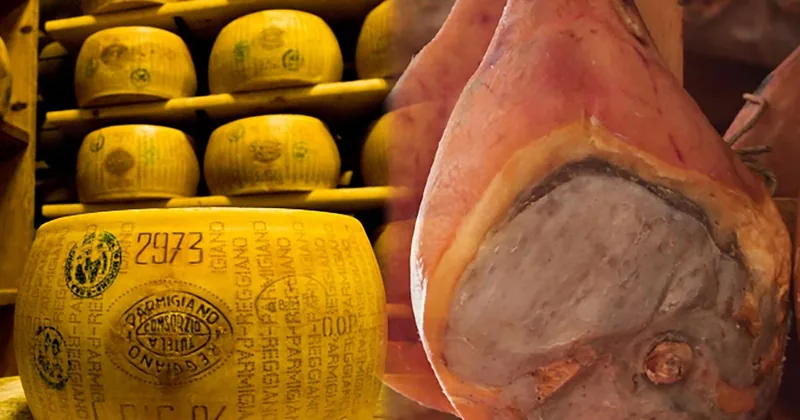 Most booked
Parma: Parmigiano Production and Parma Ham Tour & Tasting
Frequently asked questions
How much milk does it take to make one wheel of Parmigiano Reggiano?
The Consorzio gives two figures: 550 litres in its glossary and about 520 litres in its 2019 guidelines. A finished wheel weighs at least 30 kg, and about 40 to 40.5 kg on average.
How long is Parmigiano Reggiano aged?
At least 12 months, with no maximum. Most of what is sold is 24 to 36 months old. The age labels run from delicato (12 to 19 months) to intenso (35 to 45 months).
Why do they hit the wheels with a hammer?
At 12 months a battitore tests every wheel with a hammer, about ten seconds a wheel. A pass earns the oval fire-brand; a second-grade wheel is engraved with parallel lines; a failed wheel has its marks scraped off and cannot be sold as Parmigiano Reggiano.
What are the white crystals in Parmigiano Reggiano?
Tyrosine, an amino acid, not salt. The crystals grow as the cheese ages, which is why you find more of them in older pieces.
Can I watch Parmigiano Reggiano being made?
Yes, at a working dairy in the morning. Book early and aim to be there by 9:00, because the extraction happens early. What time to go.